It starts as stick figures
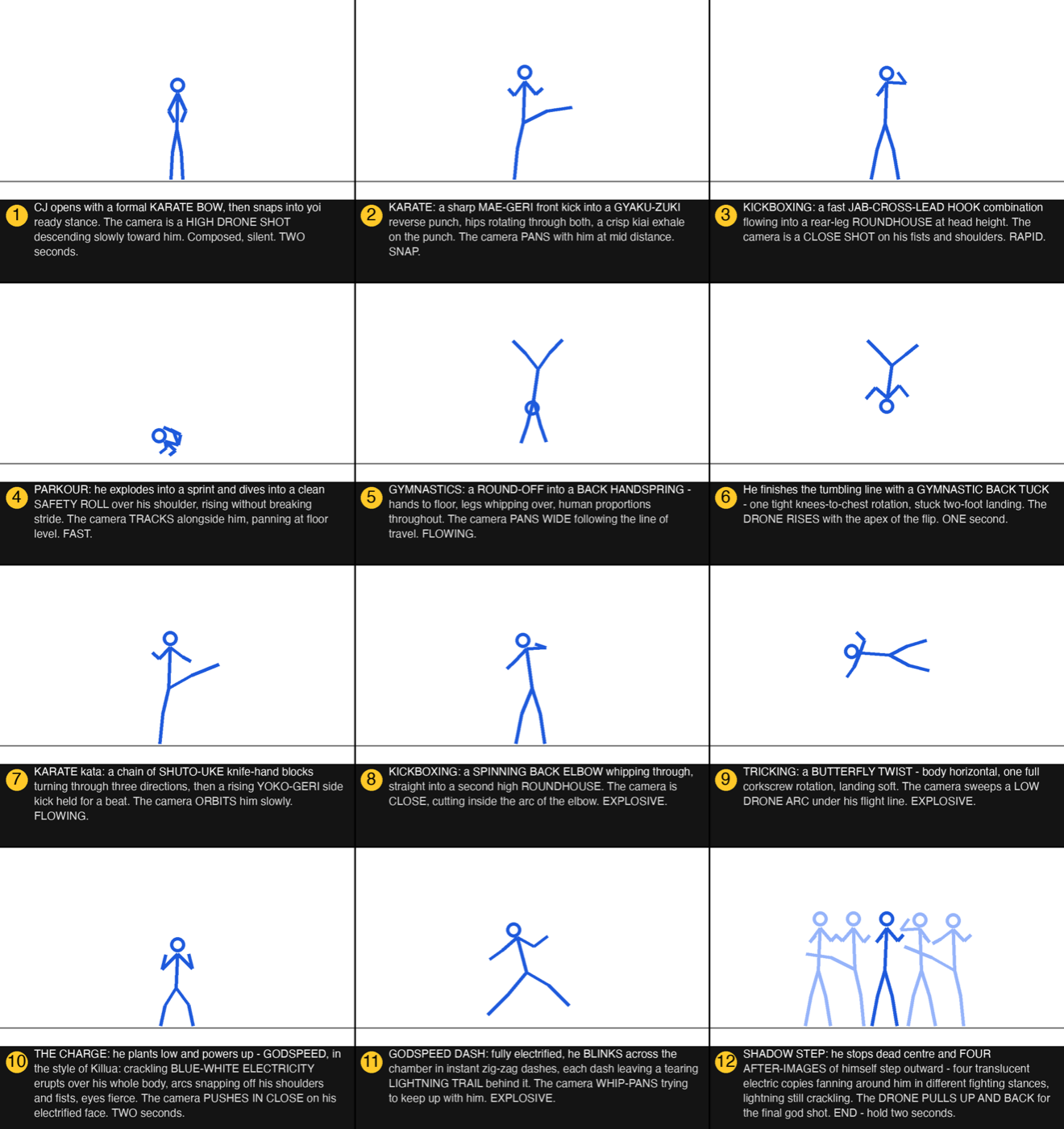
Nothing here began with a prompt describing a fight. It began with two numbered instruction sheets — twelve hand-drawn cells each, one per beat, stick figures with captions. The sheets are the direction; the model is the camera crew.

Words are the engine
The drawings carry the shape. The captions carry everything else, and they are specific on purpose: mae-geri, parkour tic-tac, back tuck, ushiro-geri. Real techniques, named.
That specificity is the whole method. Name a technique and the model performs that technique. Describe it loosely and you get a gesture in its direction. Each caption also carries an outcome and a tempo, so a cell says what the move is, what it does, and how fast it lands.
The camera reads too
The same captions direct the camera, per frame — drone, close, orbit, whip-pan. Written down, and obeyed in the render: the descending bow that opens the film, the push-in on the Godspeed beat, the rising final shot.
The camera was never a separate pass. It is another word in the cell.
The seam is the story
The film is two thirty-second takes. Joining them is usually the ugly part — the moment continuity breaks and a viewer notices the machine.
Here the join is the beat. The takes meet on a time-dilation tear, and that tear is the moment his shadows wake. Continuity across it comes from an ease-in last-frame anchor and a measured grade-match, so the two halves sit in the same room under the same light.

The score
UK Garage, written to the choreography rather than laid under it. The structure is bar-for-bar with the fight: the riser is the charge, the drop is the dash.
It came out of the in-house instrumental engine's structure blocks, generated with Suno, then mixed under the film's own sound effects.
The numbers
Two renders. Roughly £4 of generation. Twelve drawings per half.
One hundred per cent original IP — no third-party footage anywhere in the cut. The Godspeed beat is a style homage; the figure on screen is our own character, and the electric VFX are generic.
Still learning this. But the sheets worked, and that is the part worth showing.