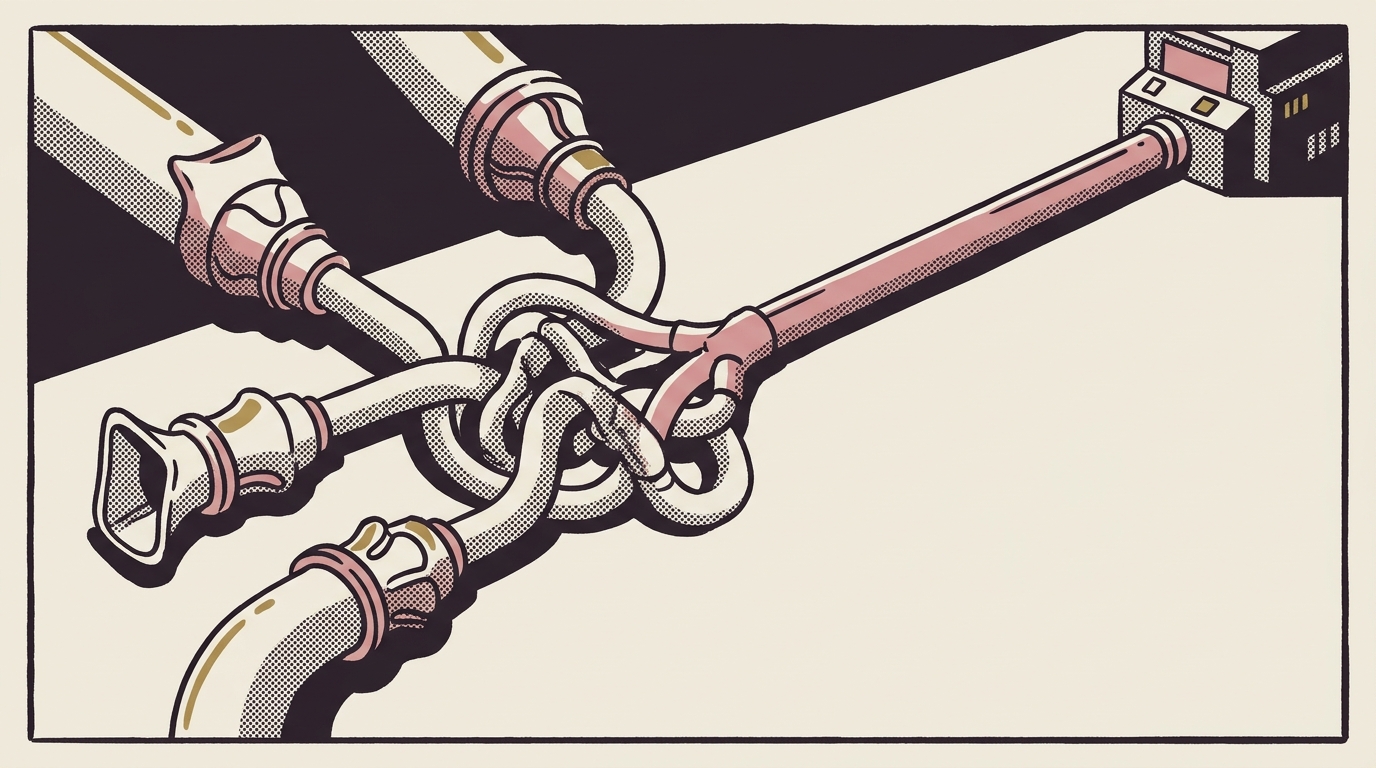
The broker had been running since 4 September, with the right API key loaded. Tailscale serve was routing “/” to port 4004. The tailnet URL was present in the config.
An iOS budget app was showing the disconnect screen anyway.
That was 16 September. Third time in five weeks I’d opened the app to the same error. The first two had been real problems. This one was different in kind: the broker was visibly up, the connection layer intact, and the app was still wrong. Working from the error message would have led me in the wrong direction, same as it had the first two times.
What the message never tells you
“Bank disconnected” is a UI concept that maps to one screen. It doesn’t map to one failure.
By mid-September I’d watched it describe a cascade delete that destroyed a database row, a signed build that shipped with a missing config file, and a Tailscale route that pointed at nothing. Three different failure layers. One message, identical each time. If I’d diagnosed the first incident and assumed the subsequent ones were the same failure, I’d have been wrong twice.
Each one had to be diagnosed despite the message, not from it.
10 August: the cascade delete
PY-030 shipped. Within the hour I’d used the transfer function, cancelled the transfer, and Monzo was showing negative two hundred. Not a display bug.
unlinkTransfer had found the transaction’s linked row (the row sharing the foreign key) and deleted it. The intent was to unlink the transfer. The side-effect was that the deletion reached further than the transfer row: the bank account’s own row was gone. The account wasn’t disconnected. It had no data left to describe it.
“Disconnected” was the app’s response to “no rows match this query.” Accurate in the narrowest technical sense. Useless as a diagnosis, because it pointed the investigation at the network rather than the database.
The fix was scope: unlinkTransfer needed to delete the transfer row, not the foreign-key-sharing cluster. After the fix the bank row survived an unlink. The error stopped occurring through that path.
By September it was back through a different one.
4 September: the missing config
Builds 27 and 28 installed on the phone without issue. Both launched. Both displayed the disconnect screen for every bank account. No build error. No runtime warning. The app started, presented the connect screen, and indicated the banks were unavailable.
The cause was dev-broker.json. The file is gitignored — it exists only in the working tree where it was first created, never committed to the repository. When git worktree add created the isolated directory for the signed build, the config stayed behind in the original tree. The build succeeded with it absent. The binary that landed on the phone had no key, no endpoint, and no route to the broker.
“Bank disconnected” was technically correct: there was nothing to connect to. It was silent about why, and that silence was the problem. A missing-config failure looks identical to a disconnected bank from the user’s side, and it looks identical from the logs unless you already know to check for it.
The fix: absent dev-broker.json should fail the build, not produce a degraded binary. The build now exits with an error when the config is missing from the worktree. A failed build is better than a silently broken one.
That commit (380bc76) carried something else along with it: Reports Phase 1, which had been sitting in the working tree since 13 August. The devlog entry for Reports was dated three weeks earlier; the code had been written then but never committed. It landed in 380bc76 as a passenger. The devlog had been claiming Reports was done since August. It wasn’t in the repository until September.
That’s a quieter version of the same problem: the state you document and the state that’s actually in the repository can diverge without any explicit failure. It doesn’t surface as a disconnect screen. It surfaces weeks later when you go looking.
16 September: the wrong address
The broker had been running since 4 September — twelve days of clean uptime, correct key, Tailscale serve routing “/” to port 4004. The tailnet URL was present in the config. The app was hitting the disconnect screen.
I diagnosed it layer by layer. Broker process: up, correct key. Serve rule: routing correctly. Config: URL present, syntactically valid. Data layer: bank rows intact. That left the tailnet route itself. The URL the app held had drifted: once a valid address, now pointing nowhere. The broker was reachable from the machine running it. It was not reachable from the address the app was sending requests to.
The devlog entry title for that day captures the distinction: “a broker you cannot reach is not a bank you are not connected to.” The difference matters because the recovery path is different. Disconnected bank: re-auth. Unreachable broker: fix the route. The app had one screen for both states and no way for the user, or the initial investigator, to tell them apart.
The diagnostic pattern
Three incidents, three layers:
- Data. A cascade delete removed the row that described the bank account.
- Config. A gitignored file absent from the build worktree silently degraded the binary.
- Network. A tailnet route had drifted from a valid endpoint to a dead one.
The UI presented all three identically. The error message trained the wrong diagnostic instinct: each new occurrence pushed investigation toward the most recent fix. After the cascade delete was resolved, the next incident looked like another data problem at first glance. After the config fix, the next one looked like it might be another config problem. Each time, it wasn’t.
What made September’s diagnosis faster than August’s wasn’t better tools. It was the prior: “this message has lied before.” Layer-by-layer diagnosis is slower on the first incident. It’s faster on every one after.
What changed
The cascade delete is a closed class of failure. The scope was wrong; it’s been corrected. That specific path doesn’t recur.
The gitignored config fix is directional. dev-broker.json now fails the build when absent from the worktree, which closes that gap. The category isn’t closed: any project using git worktree add for signed builds has the same exposure for every other gitignored file that happens to be load-bearing. Worth auditing as a category, not just patching the file that surfaced first.
The tailnet route is the least satisfying outcome. The misconfigured address was corrected, but a route that was valid and then drifted doesn’t have a code fix. It’s configuration that needs periodic verification. The class of failure stays open.
The error message is still too broad. “Bank disconnected” covers all three failure modes without saying which layer failed. Separating them (config absent, broker unreachable, data error) is a later sprint. Until then: ignore the message, work from data to config to network, and verify each layer independently. Five weeks of the same screen, three different causes, made the order clear.